I’ve been asked by a reader of this magazine to write an article about people getting along.
The reader said — there are so many different personalities, and sometimes people don’t click, but they can still get along. Just need to be reminded that it’s not rocket science getting along with people…and to not be the “problem”!
I’m sure you agree with the reader, there are many personalities. Yes, there are multiple assessments to learn about different interpersonal styles. But we’re not going to address the different styles; instead, I’m going to attempt to get into your brain, but as the reader said, this is not rocket science.
I’m sure you agree with the reader, there are many personalities. Yes, there are multiple assessments to learn about different interpersonal styles. But we’re not going to address the different styles; instead, I’m going to attempt to get into your brain, but as the reader said, this is not rocket science.
Have you noticed the friendliness of your pet dog? All a dog wants to do is express and receive affection. We can show our frustration with the dog, and in the next second, the dog returns to wanting to give and receive friendliness. Of course, if we continue to psychologically or physically abuse the animal, we will teach it to avoid us.
Like dogs, we’re hardwired to be social animals. This means that we need to be both physically and psychologically touched by another human, who, in turn, needs to be physically and psychologically touched by us. Given these facts leads to the question, “Why” do some people act in ways that interfere with interpersonal relationships? The complex answer lies within our psyche. That is, the environment in which we grew up impacted our mindset, resulting in some ineffective, or should I say, crazy biases stamped into both our conscious and unconscious minds.
Examine the following illustration of ego strength for a moment.
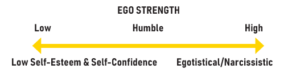
Let’s define ego strength as a sense of our self-worth. All of us have one, and to my knowledge, we learn it rather than it being determined genetically. You can see the results should we fall at either end of this continuum. Humility is defined as being proud of who we are while at the same time recognizing we’re in a state of development. Thus, our ego strength can be an asset when expressed through humility or a personal liability when expressed through the categories depicted at either end of the continuum.
The humble person will overall have the more effective interpersonal skills, as these individuals are confident, have positive self-esteem, and have no psychological need to impress, control others, or inflict physical or psychological pain upon others, to name a few examples.
Based on my experience working with people during my career, most people have not completed the self-analysis to identify the root causes of “why” they act this way. Yes, I would like to be able to tell you the specific reason(s) people use interpersonal skills that cause pain in other people’s lives. Doing so is impossible. Despite the amount of soul-searching I’ve done over the years, I don’t even know all of my “whys” I am like I am.
As crazy as this may sound, the reason a particular behavior is repeated is the benefit the person derives from it. Yes, the employee who acts like a horse’s butt continues that behavior because they receive a benefit from that action. And the benefit gets crazier because we’re either getting something we like or avoiding/escaping from something we don’t like.
Regardless of whether we have insight into what is driving our behaviors, most people can make the necessary decision to use highly effective interpersonal skills. The one exception might be the narcissist who believes everything they do is great. Study the following behavioral blueprint:
1. The starting point is self-awareness when we are about to use ineffective interpersonal skills. Self-awareness is also a challenge, but with practice, we can become better at being aware of our emotions which drive our actions. As much as I hate to tell you this, without being self-aware, we will continue our journey to act like a jerk.
2. We exhibit control by telling ourselves to stop and think. Then ask, do I want to make a good choice or a bad one? Obviously the better of the two choices is a good one.
3. Now, being in control, the next step is to use more effective interpersonal skills.
I am of the opinion that we all have the natural resources to be kind, say nice things, smile, etc. It’s more a matter of doing than it is learning the skill sets to be the person with whom others like to work.
In closing I’ll use myself as an example. I grew up shy and introverted which are not the most effective interpersonal skills. When I started college, I watched people who acted friendly and mimicked their behaviors. Yes, I had to practice making eye contact and even telling people good morning! The point is, to improve the habit strength of that simple behavior required a lot of practice and I still practice that behavior when walking in stores and at the airport. Of course, I’ve made a few blunders during my practice sessions, but we learn from our mistakes.
I would recommend reading Christine Porath’s books Mastering Civility and The Cost of Bad Behavior, where you will learn the impact of acting like a jerk within your dealership. Also, Google and read The Two Wolves Inside of You, a one-paragraph description of a Native American grandfather’s advice to his grandson.
Article Writtle By Larry Cole, PH.D.
 LARRY COLE, PH.D., is a lead trainer for and consultant to the North American Equipment Dealers Association’s Dealer Institute. He provides onsite training and public courses to improve business leadership effectiveness and internal and external customer service. Please send questions and / or comments to Larry at teammax100@gmail.com