Growing up in rural Saskatchewan afforded me a firsthand look at farming.
Both my father and my uncle owned Massey Ferguson dealerships. Many relatives in the area owned large farms. From an early age, I would help out on the farms and in the dealerships.
Once my father and I were involved in an accident while hauling a very heavy rock picker behind our pickup truck. As we were crossing train tracks, the truck inadvertently connected with the tracks. While the truck and hitch suffered significant damage, the end result could have been much worse.
Subconsciously, I think I always knew that one must be careful around big agricultural equipment. Yet after all those years of working in agriculture, not once was safety part of the discussion.
Who wants to talk about safety? No one – until there is an accident or a near miss, then it’s all-hands-on-deck to figure out what went wrong, how to fix “the problem” and how to prevent it from happening again.
This past winter, I spent a lot of time traveling to Ag shows through Western Canada and the American Midwest. At every show, I heard a similar story. “We had a bad accident on the farm.” Or “We had a near miss while changing tires on the farm.”
Often, the dealers or farmers I talked to couldn’t justify the investment in safety equipment to change tires. Some said, “The young guys can do it.” Some said they hire the job out and let others worry about potential injuries.
Fatal injury stats are staggering
While many farm-related accidents go unreported, the number of recorded accidents resulting in fatalities tell a grim story alone.
In the United States, the mortality rate is 23.1 deaths per 100,000 which, based on the US latest census data of 1.89 million farms (USDA Feb 2024), works out to 436 farmers killed every year on the farm in the United
States.
In Canada, the Canadian Agricultural Safety Association (CASA) reports that on average, there are 84 fatalities per year. These numbers are staggering.t
So, how can we fix it?
Taking proactive steps can help minimize the risk of injuries related to agricultural tasks such as changing large scale tires on farm equipment.
- Start with a safety program that includes specific steps and procedures.
- Train all workers on the correct procedure for changing tires.
- Always use personal protective equipment (PPE).
- Discourage short-cuts.
- Review possible risks and take action to prevent injury.
- Always use equipment that is purpose-built for the task.
The growth of the farm tire
Historically, farm equipment and, consequently, farm tires were much smaller. Tires could be changed by hand or with the use of front-end loaders, skid steers or forklifts. Jacking up equipment with cribbing and bottle jacks was the norm. With the help of chains and a lot of grunt work, almost anyone could do it.
As agricultural equipment became more sophisticated – designed to work more ground in less time, streamline operations and help farmers grow their business – the tires that kept things rolling also grew. Eventually, the practice of using chains, skids and a few strong workers to change a 4,000 lb tire came into
question. Is this really safe? The answer is “no”.
The safe way to change tires on agricultural giants

JD Spray changeover and the proper way to stack tires on a skid.
Changing oversized tires on sprayers, tractors and large ag trailers, safely and effectively really boils down to the right equipment.
Let’s look at today’s high clearance sprayers for example. These high-tech machines are so tall that a person well over 6 feet in height can walk underneath them! With that in mind, the old way of jacking them up becomes onerous.
The safest way is to use a wide-based, high jack such as the TG Equipment Jack system that can lift the entire end of the sprayer off the ground and hold it stable. The TG Equipment Jack is remote-operated and has a builtin 12V battery and hydraulic pump system that can lift up to 30,000 Ibs! The jack is wide enough to lift both sides of the sprayer at the same time, and it rises high enough to safely lift any sprayer (with the right options including
lifts and risers) – no matter how tall it is.
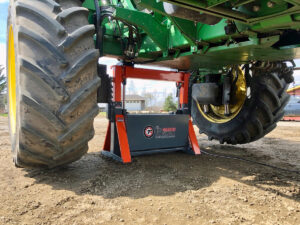
The TG Equipment Jack is designed specifically for the large sprayers.
With the sprayer lifted and the tires off the ground, how do you get the wheel/tire combo off and the new set on? This mammoth task is often accomplished by hand using front end loaders, skid steers or forklifts and a team of workers. Once the tire/wheel is disconnected from the sprayer, it is leaned against the machine (and sometimes chained) or set against a building for storage. This method of changing tires is fraught with danger. The tire/wheel combination can weigh more than 2,000 lbs, which is far beyond the ability of most workers to handle.
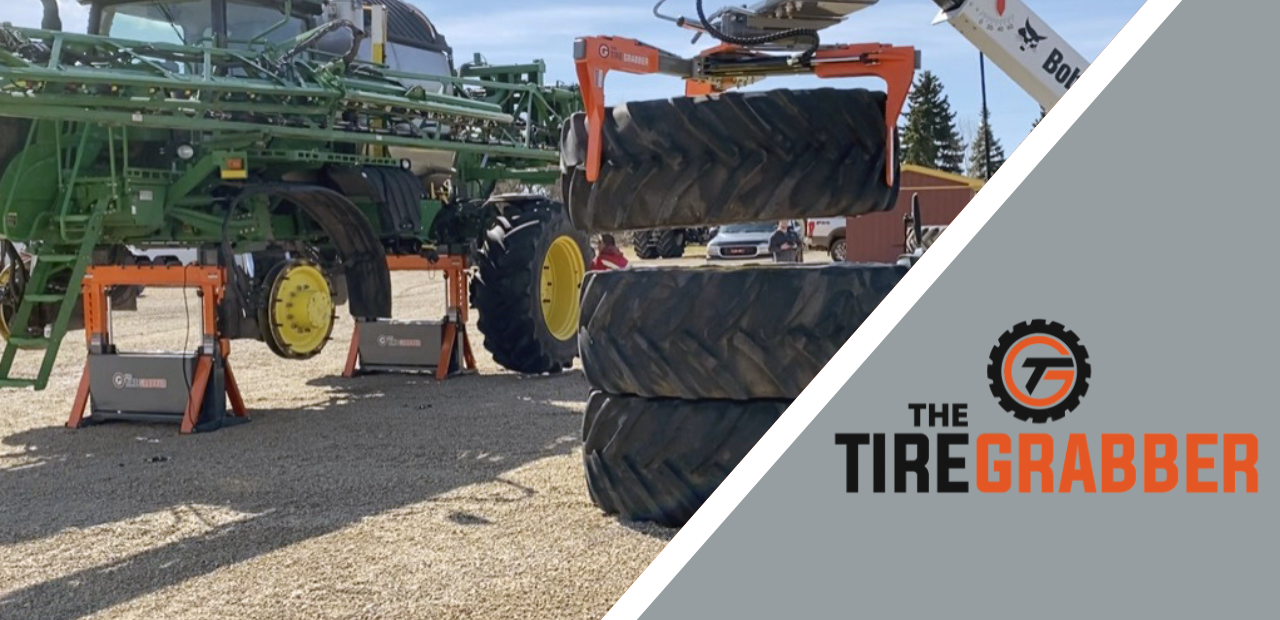
An easy, effective solution is to use the TireGrabber tire handler. It simply mounts to most loaders, skid steers, telehandlers, cranes, and forklifts and can be used to lift, stack and move tires up to 95” diameter and 4,000 lbs. The patented, engineered TireGrabber has a three-arm grabber that provides secure gripping, allowing the operator to support the weight while the nuts or studs are taken out. After the tire is off the machine, it can then be stacked on a skid for safe and easy storage.
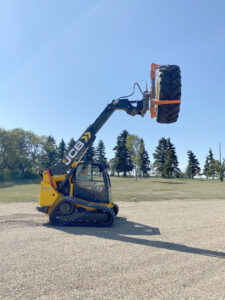
The TireGrabber mounted on a skid steer.
To put new tires on, the opposite occurs. You pick the tire up off the skid with the TireGrabber and bring it to the machine. The operator can easily rotate the tire to line up with the studs. Instead of a team of workers, two people can change tires, safely and efficiently. I’ve been told a story about two farmers changing a set of tires on a sprayer using the TireGrabber system in under 30 minutes – and they had fun doing it!
Once the old tires are off, rather than store them upright leaning against a wall, the safer way is to stack them on a pallet using the TireGrabber. Then the pallet can be stored safely and easily. It is recommended that tires be stored out of direct sunlight and away from ozone created by welders, electric motors and transformers. They should be stored at the proper inflation and, if stacked, kept mounted on the wheels and inflated. (Titan 2024)
From a management perspective, the TireGrabber system ensures that all employees and/or workers will be safe handling sprayer, tractor and other tires whether on the farm or in a tire dealership. But also important in this
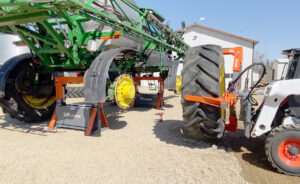
The TG Equipment Jack changing a JD Sprayer
tire with The TireGrabber on a skid steer.
discussion is the ROI. The number of hours saved is significant using the TireGrabber system versus other methods, which is important when it comes to productivity. Another important point is that not only will service departments be happier but using the TireGrabber system in the field also improves customer satisfaction as the changeover of tires is done in a fast, efficient and safe manner.
Everyone has the right to work in a place that protects their wellbeing so they can return home to their families every day. The safe handling of large farm equipment tires is a vital part of farm safety. It is important to be aware of the risks involved, and to take precautions to reduce the risk of injury for everyone.
Article Written By Gerard Zentner
 GERARD ZENTNER started from the ground up, building successful businesses from his kitchen table. Now, with over 40 years of experience under his belt, Gerard is CEO of the TireGrabber – a patented device that makes changing large equipment tires safer, faster and easier. The ingenious invention of a farmer who had a need and a vision, the TireGrabber mission aligns with Gerard’s drive to deliver smart solutions for real-world problems.