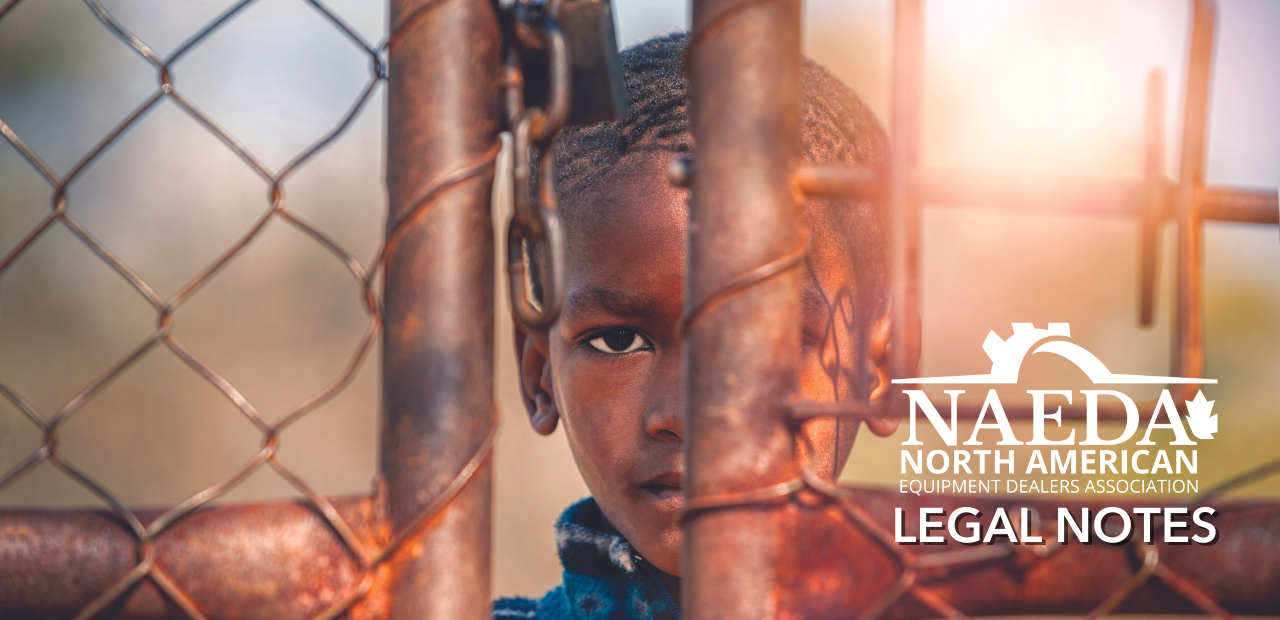
Before it arrived fully assembled in your dealership, whose hands did a piece of equipment pass through, and how free were those hands?
In recent years, governments around the world have been passing legislation to combat the prevalence of forced labor and modern slavery within the global economy—Canada being one of the most recent. In May 2023, Canada passed the Fighting Against Forced Labour and Child Labour in Supply Chains Act, commonly referred to as the “Modern Slavery Act,” making it law. The Act requires any entity that falls within its scope to make an annual public report about the steps it is taking to prevent and address forced and child labour both in its operations and down its supply chains.
Unlike similar laws in other jurisdictions, Canada’s Modern Slavery Act gives broad powers to the Minister of Public Safety around compliance and enforcement, including the authority to prosecute directors and officers and levy significant fines. Understanding this evolving area is critical to effective risk mitigation.
Dealers that do business in Canada must now consider the impact of this law on their trade operations. If your business is subject to annual reporting, its first report is due no later than May 31, 2024.
The Modern Slavery Act
Background
“Modern slavery” is an umbrella term that typically refers to forced labour, child labour, human trafficking, and various forms of exploitation such as debt bondage and forced marriage. The Modern Slavery Act specifically targets forced and child labour, the aspects of modern slavery that most affect the private sector. The ILO estimates that 24.9 million people globally are in some form of forced labour, while 160 million children are subjected to child labour, of which over 79 million are in hazardous work. Modern slavery is especially prominent in labour-intensive industries, including manufacturing and the agricultural space.
Most goods travel through a long and complex supply chain before reaching the consumer. The supply chain may include extractive industries, producers, manufacturers, distributors, and retailers. The commercial farm equipment industry, like many others, can be subject to various legislative frameworks, which may include similar reporting regimes to Canada.
What Is the Act?
The Modern Slavery Act came into effect on January 1, 2024. The new legislation applies to certain public and private entities, including foreign-owned businesses that supply, produce, store, or import goods to Canada. Companies that are subject to the Act must make a public report detailing the measures they have taken in the past yet to prevent or mitigate the risk of forced or child labour being used anywhere in their operations or supply chains.
How Does the Act Compare to Its Global Counterparts?
Canada’s Modern Slavery Act is not the first of its kind: similar legislation aimed at eliciting transparency to combat slavery in global supply chains has been passed in other jurisdictions.
National legislative measures have typically followed one of two approaches:
1. imposing transparency-focused reporting requirements; or
2. compelling businesses with global supply chains to implement due diligence measures.
Canada has embraced the first of these models; a transparency-focused reporting requirement. This approach, in common with other Commonwealth nations and California, mandates companies to provide a yearly public report on their efforts to eliminate modern slavery from their supply chains.
Transparency legislation from the United Kingdom, Australia, and the State of California share strong links with the Act, although certain key differences exist in the legislation that informed the structure of Canada’s Modern Slavery Act—most importantly, Canada’s broader inclusion of businesses and greater enforcement measures.
In contrast with similar regimes, non-compliance with the Canadian Modern Slavery Act can attract severe penalties. Failure to produce, publish, or make available an annual report is an offence punishable by fines up to C$250,000. The Act goes even further by engaging directors and officers’ liability, meaning directors, officers or agents who participate in any violation of the Act are also subject to penalties. As a result of the substantial sanctions, businesses operating under the Act require robust governance controls.
Is Your Business Subject to the Act?
The Act applies to Canadian public companies and certain private organizations that produce, sell, or distribute goods in Canada or abroad, or import goods into Canada.
For a private organization to be in scope, it must have a connection to Canada (i.e., it has a place of business, “does business” or has assets in Canada) and meets two out of the following three size thresholds: C$20 million in global assets, C$40 million in global revenue, or 250 employees.
Commercial farming equipment qualifies as “goods” under the Act; therefore, dealers engaged in trade activities will be required to report, provided that their businesses meet the connection to Canada test and size thresholds.
How to Report? — The Basics
To meet the reporting obligations under the Act, entities are required to complete an online questionnaire in addition to submitting a report to the Minister of Public Safety. The Canadian government has published guidance for preparing, and submitting a report.
1. Fill Out a Questionnaire
In addition to submitting a report, government guidance indicates that entities must complete an online questionnaire that includes a series of open- and closed-ended questions. The questionnaire is designed to collect information necessary to satisfy the requirements of the Act. It will also confirm that the affiliated report has received the requisite approvals and includes a signed attestation.
2. Submit Your Report
The report is limited to 10 pages or less and must be approved by the entity’s board of directors, then submitted on or before May 31st of each year to Public Safety Canada. The contents must address the steps the entity has taken during its previous financial year to prevent and reduce the risk that forced labour or child labour is used at any step of the production of goods imported into Canada by the entity. To comply with the Act, a report must include each of the requirements set out in subsections 11(1) and 11(3) of the Act, summarized below.
The report must include:
- The entity’s business structure, activities, and supply chains
- Applicable policies and due diligence
- Steps taken to assess and manage the parts of its business and supply chains that carry risk
- Steps taken to remediate any forced labour or child labour
- Training provided to employees
- How the entity assesses its effectiveness in ensuring the absence of forced labour and child labour
- Each reporting entity must also publish its report in an accessible place on its company website.
3. Understand Due Diligence
The Act does not require reporting entities to carry out any particular form of supply chain due diligence. However, as mentioned above, the contents of the report must be true and accurate, or the company and its directors and officers may face criminal fines.
As such, each entity must assess what level of due diligence is required in order to satisfy market expectations and its liability risk. This may include investigating the supply chain beyond the first tier, adopting codes of conduct both with the business and for suppliers, adapting contract language to allow for proper monitoring of supplier and sub-supplier conduct and any eventual remedial action, and considering the need for internal or external audit and verification.
Tools for NAEDA Dealers
To assist NAEDA Dealers in preparing to report, BLG has put together a series of tools that are designed to provide a foundation for compliance and a guide to reporting. These tools include:
- A detailed guide to reporting under the Modern Slavery Act (the “Playbook”);
- A reporting template with accompanying guide and questionnaire to help you draft a report that covers all the mandatory areas set out in the Act;
- A template Supplier Code of Conduct;
- Webinar-based training for employees.
In particular, the Playbook provides an overview of how the Act is intended to work, what different types of compliance look like, and what you should consider in your overall business strategy towards reporting. The other tools are intended to provide the essential building blocks for compliance.
For more information please contact
Larry Hertz, VP, NAEDA Canada at
1-800-661-2452 or email: lhertz@naeda.com.
Article Written by Benedict Wray, PhD, is an English- and Ontario-qualified lawyer at the law firm Borden Ladner Gervais LLP.
 Benedict Wray, PhD, is an English- and Ontario-qualified lawyer at the law firm Borden Ladner Gervais LLP. His practice includes international arbitration, administrative law matters and a range of business and human rights issues.
Benedict has experience representing and advising clients on modern slavery and business & human rights issues in Canada and globally. In 2019, he represented his former firm in a consultation by the Canadian federal government regarding modern slavery legislation, and he regularly gives guest lectures on modern slavery and business and human rights topics at the University of Ottawa and the Nova School of Law in Lisbon, Portugal. Benedict is a member of BLG’s Environmental, Social and Governance (ESG) steering committee.