With Right to Repair becoming a political football, it is subject to the same dynamic all our politics have succumbed to in this era.
Misinformation isn’t even an accurate enough phrase to describe what we encounter. There’s a whole typology that includes mal-information, disinformation, and out-and-out lies to sift through. How do we contend with all this on an issue as complex and hyper-technical as Right to Repair? As it turns out, the answer is to treat everyone like they are from Missouri – the Show Me State.
Dealer demonstrations have become the most effective method of combatting all types of misunderstanding and confusion about the reality of the repair landscape and showing that our industry is a leading example of one supporting customer self-repair.
Once the baseline of reality is established, the policy discussion becomes much more reasonable as people understand what we are really discussing.
Bringing Stakeholders to the Dealership
One of the primary problems we face with the issue of Right to Repair, much like other issues today, is having the real stakeholders involved in resolving the issue. There are certainly outside groups with no connection to production agriculture that have pushed this issue forward. We can’t control who will testify at a public hearing or try to raise money off the issue, but we can control who is brought to the dealership to discuss the issue in good faith, intending to be transparent and resolve it. In our minds, that certainly begins with the producers themselves and includes elected officials.
From our earliest dealer demonstrations, we have always sought to bring the Farm Bureau, Federations of Agriculture and other commodity and policy groups into the dealership. These are the people who have real skin in the game and are knowledgeable about what works and what doesn’t. Their input has been invaluable in moving forward with more product offerings that support self-repair from all the manufacturers. And the Farm Bureaus, Canadian Federations and commodity groups have been more than willing to meet with dealers and manufacturers to work towards that goal. To further that point, equipment demonstrations were the initial collaboration that culminated in the Memorandums of Understanding between the American Farm Bureau Federation and farm equipment manufacturers.
For legislators, equipment demonstrations are eye-opening experiences. They first notice that we are fully transparent in discussing what is available to support customer self-repair. The second thing they notice is how much is currently available directly to customers and the lengths dealers go to in supporting their customers. By that, I mean legislators are not commonly familiar with the amount of parts inventory dealers have, what fill rates dealers strive for, and how dealers work around the clock to keep their customers up and running. It becomes very difficult to believe that dealers are anything other than fully committed to supporting their customers’ uptime once legislators have the experience of seeing firsthand how much dealerships invest in and do to achieve that goal.
The Growth of Dealer Demonstrations
To my knowledge, the first dealer demonstration relating to Right to Repair was held in McPherson, Kansas, in 2019. The event was held at Prairieland Partners and involved the Kansas Farm Bureau, several manufacturers, and NAEDA staff. It was a test run in many ways, and we weren’t sure whether the format would work. In large part, that first demonstration has become a template for nearly a hundred demonstrations to this point.
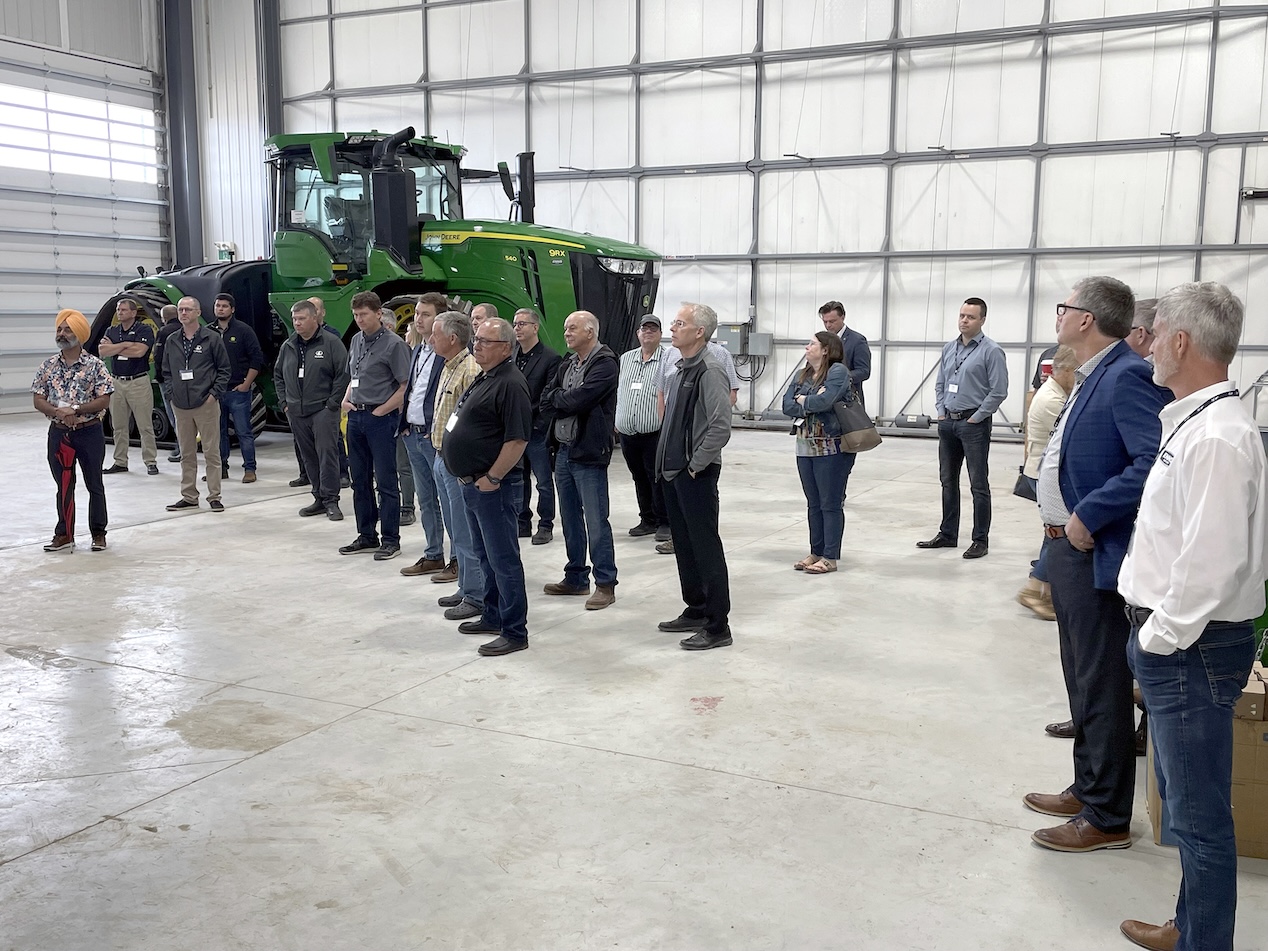
For those who have yet to take part in one, a dealer demonstration follows a classroom format and ends with a hands-on demonstration. In the classroom format, dealership personnel will kick things off with a welcome to all attendees. Association staff follow with a brief, broad overview of the Right to Repair issue and where it stands today legislatively. Then, we dive into the actual meat of the presentation with a manufacturer representative walking through what is available from a parts, tools, documentation, and diagnostic perspective to support customer repair. Even for people very familiar with the issue, this generally leads to some ah-ha moments about the range of products and services that are out there.
We take people from the classroom to the shop floor to demonstrate our discussion. Without fail, the technicians steal the show with their acumen and ability to explain everything in technical and layman’s terms. This is always the best part. Whether it’s a very knowledgeable producer or a legislator touching farm equipment for the first time, everyone seems to learn something new. And in the digital era, plenty of pictures have been taken to prove that it happened.
“The Right to Repair demonstration was an eye-opener for all stakeholders. It provided a deeper understanding of the invaluable technology and support that dealers offer to customers, highlighting the essential role they play in ensuring seamless and efficient service.” – John Reddin, CEO Green Diamond Equipment
The Practical Effect of Hands-On Demonstrations
The most salient point of the demonstrations is that they dispel misleading information. A committee room or legislative chamber floor is not the place to try and prove something. At the dealership, nobody can claim that a manual is unavailable because you can point to them right on the shelf or bring it up on the website with the complete schematics that immediately show what is available. The same goes for parts, tools, and diagnostics. In other words, the truth becomes self-evident; in today’s world, that is seemingly the only thing people can’t refute.
Once the baseline of reality is established, the policy discussion becomes much more reasonable as people understand what we are really discussing. Narrowing the focus puts the ball in our court to explain that we support the Right to Repair but oppose the legislation because the issue is not about access and availability; it’s about opposing legislation that dictates price fixing and allows modification affecting safety and emissions. When the discussion is rationalized to the heart of the matter, real stakeholders and elected officials understand that the legislation is misleading, not our industry practices.
Continuing to Educate
Dealer demonstrations have been a critical component to our advocacy on the Right to Repair issue. We have held demonstrations in dozens of states and several provinces. We have several more planned throughout the fall, mainly in the northeast and eastern Canada. In many states where demonstrations have been held, they lead to exemptions for our industry in Right to Repair legislation. That is the goal, and we will continue to facilitate dealer demonstrations wherever possible to avoid misleading information that propels legislation forward that would be catastrophic to our industry.
With that said, to anyone reading this, if the association approaches your dealership to host a demonstration, we sincerely hope that you take the opportunity up. To everyone who has hosted a demonstration in the past, thank you for taking your valuable time to support the industry.
 ERIC WAREHAM is senior vice president of government affairs for NAEDA. He has extensive legal and policy experience in both a trade association and the private sector. Prior to joining the association, he was general counsel for an Oregon-based heavy civil construction company. He also served as the director of government relations and general counsel for an association in the wood products industry, has managed state and national political campaigns and held numerous positions in a state legislature. Wareham is a graduate of the Willamette University College of Law and Augusta University.